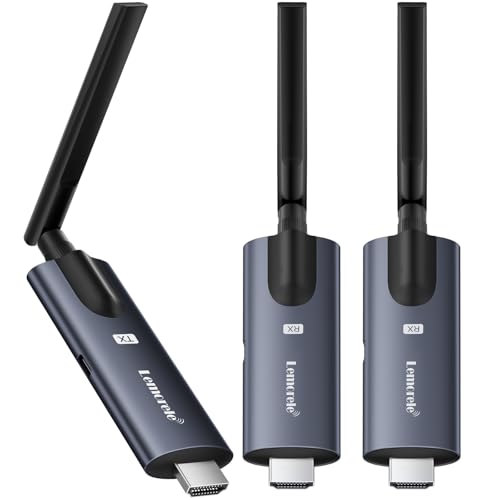
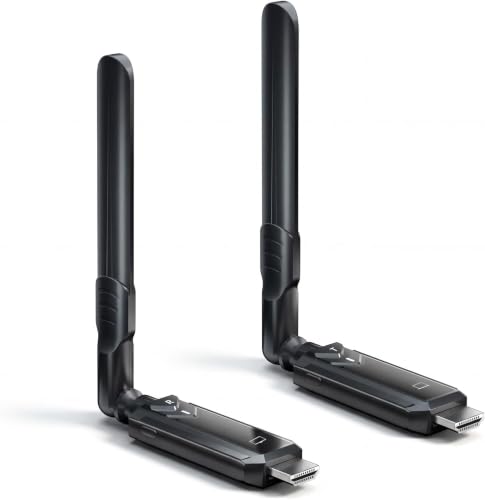
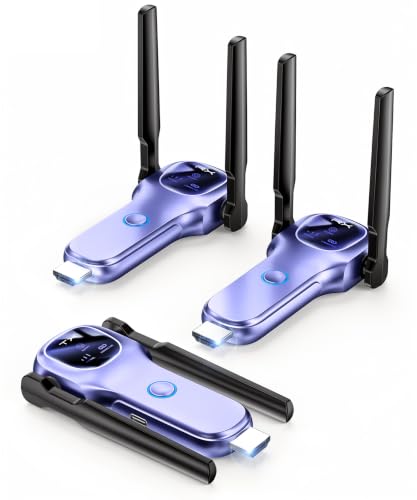
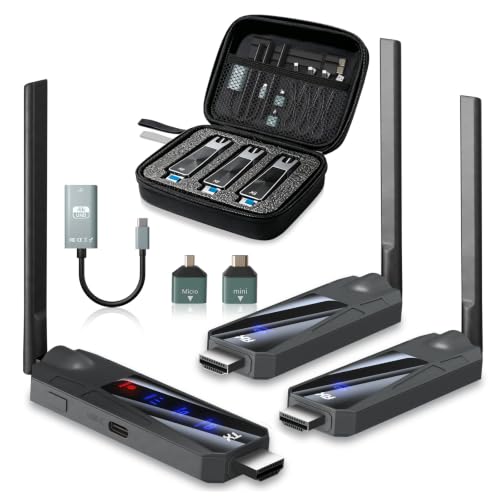
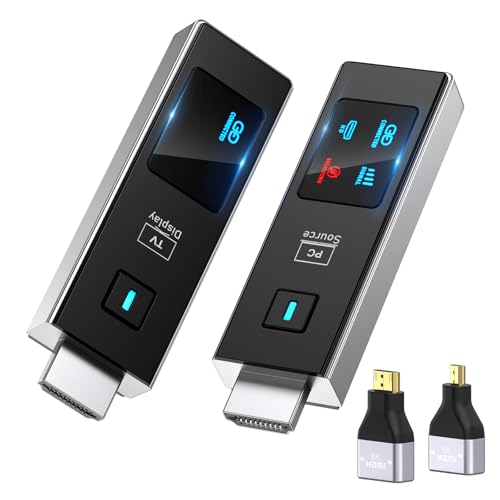
Lemorele Wireless HDMI Transmitter and Receiver 5Ghz
Long-range transmission up to 656 feet.
Supports high-quality 1080P 60Hz streaming.
Easy setup with plug and play feature.
We compared the top Hdmi Transmitter And Receiver products so you can quickly spot the strongest options for value, features, and everyday performance.
Long-range transmission up to 656 feet.
Supports high-quality 1080P 60Hz streaming.
Easy setup with plug and play feature.
Long-range transmission up to 328 feet.
Supports 4K decoding for clear video.
Simple plug-and-play setup.
No WiFi needed for seamless connection.
Supports 4K decoding with low latency.
Plug & Play setup for easy use.
Seamless 5G transmission for uninterrupted streaming.
Simple plug & play setup, no hassle.
Long-range connectivity up to 164FT/50m.
Long-range connectivity up to 165 feet.
Supports 4K streaming for clear visuals.
Compatible with a wide range of devices.
Transmits high-quality 4K video seamlessly.
Impressive 165FT/50M wireless range coverage.
Easy setup with no noticeable lag.
Supports 4K resolution for crystal-clear visuals.
Dual-band 2.4 & 5G ensures stable connection.
Plug & play setup simplifies installation process.
Impressive 360FT range for flexible setup.
Supports 4K decoding with smooth 1080P output.
Easy plug-and-play with dual-band streaming.
Supports up to 8 receivers simultaneously.
Long-range transmission up to 820 feet.
Includes IR remote and HDMI loop out features.
Impressive 328ft long-range transmission capability.
Convenient plug-and-play setup for easy use.
Dual-band connection for stable streaming.
An HDMI transmitter and receiver kit transmits audio and video signals from a source such as a laptop, camera, gaming console, cable box, or a smartphone with video-capable USB-C to a display like a TV, monitor, or projector without the need for a lengthy HDMI cable. Some kits operate via a direct wireless connection without requiring a router, app, or Bluetooth pairing; others support casting from phones or tablets, multiple receivers, local loop-out, or extended desktop modes.
The primary consideration is the output format. In this context, “4K decode” typically indicates that the device can accept or process a 4K input signal, not necessarily that the wireless HDMI output displays in 4K. Several reviews differentiate between 4K input decoding and 1080p at 60Hz output. Buyers should verify input and output specifications separately, including refresh rate, HDR, color modes, audio formats, EDID behavior, and HDCP version. A product claiming 1080p at 60Hz should specify this in its manual or datasheet. Stronger claims require model-specific interoperability testing against the stated HDMI and HDCP conditions.
Range specifications are conditional. Open-area or line-of-sight distances are not reliable indicators of performance through walls, floors, metal structures, or in congested 2.4GHz and 5GHz environments. Some manuals specify indoor or through-wall limits separately, while others only provide a maximum range figure. Consider factors like radio band, antenna arrangement, channel management, wall conditions, packet loss, reconnection success, and interference. The maximum range with multiple receivers may be less than the distance achievable with a single transmitter and receiver.
Terms such as “zero latency,” “0.01-second,” or “low latency” are not precise measurements alone. Wireless video often uses compression standards like H.264 or H.265/HEVC, which can introduce delay and affect image quality. For applications requiring real-time response, such as gaming, live camera control, or production, seek documented end-to-end latency figures specific to the retail model and firmware, including resolution, frame rate, and testing methodology. Relying solely on seller graphics, customer reviews, or unverified certificates is insufficient.
Legality of the radio transmission and electrical safety are separate concerns. For wireless transmitters, the U.S. market requires an FCC equipment authorization—this includes the grant, labeling, photographs of internal and external components, operating configurations, radio testing results, and RF exposure documentation. An FCC claim without a corresponding authorization record is not valid. Safety certifications like UL, Intertek ETL, or CSA listings for the specific configuration—covering the power adapter and kit components—are also essential. While many products use 5V USB power, this alone does not certify the safety or completeness of the power supply or the kit.
Finally, verify product identity and support. The model name, manufacturer, FCC grantee ID, manual, warranty, firmware, and seller information should be consistent. Reliable support paths are vital in case of wireless connection failures or recalled components. Check recall records from CPSC and SaferProducts.gov, but note that the absence of a recall does not guarantee safety. For end-of-life considerations, look for specific material disclosures, available repair or take-back programs, and responsible electronic recycling options. Generic claims such as “RoHS” or “eco-friendly” should be backed by documentation.
Overall, reviews highlight significant safety and performance concerns: many products lack UL, ETL, or CSA certifications; independent testing of latency, range, dropouts, image quality, and reconnection was generally missing; and security aspects like HDCP, encryption, and pairing were often undocumented or inconsistent. Several claims related to range, 4K capability, dual-band operation, or zero latency were qualified or questionable in the manuals. These products are not recommended for critical applications such as competitive gaming, live camera feeds, medical displays, or any timing-sensitive tasks unless their performance has been independently verified.

The reviews provided indicate that the main differences typically lie in radio traceability and claim clarity, rather than in full product certification. The following points outline what to verify before considering a wireless HDMI kit appropriate for a specific room, display, or safety-sensitive application.
This ensures protection against electrical shock, overheating, and fire for the transmitter, receiver, cables, and power supplies. It is important because many kits need separate USB or 12V power sources at both ends. Products with high safety scores are backed by reputable certifications from UL, ETL, or CSA for their specific configuration. In contrast, lower-scoring products typically only include operational warnings or specify low-voltage details without a recognized safety certification.
This assessment determines whether the specific transmitter is authorized for sale in the United States and whether it has documented emission and RF exposure conditions. This is important because these kits deliberately transmit on the 2.4 GHz or 5 GHz radio bands. High scores in the evaluation were achieved when FCC approvals matched with labels, photographs, radio testing results, and exposure documentation. Conversely, lower scores were assigned when records appeared similar but lacked official grants, had missing documentation, or when there was uncertainty about whether the filings covered the version being sold.
This assessment records the material restrictions of the product and evaluates whether it can continue to be useful, repaired, reused, or responsibly recycled. This is important because a wireless kit typically contains electronics, power cables, adapters, and sometimes external antennas. The products generally received moderate scores: higher scores indicated the availability of support or warranty options and some material information, while lower scores were associated with the absence of model-specific RoHS or chemical disclosures, repair parts, take-back services, or recycling plans.
This metric evaluates whether claims honestly describe their actual capabilities and differentiate between decoding and output. It is important because terms like “4K,” “long-range,” and “zero latency” can sometimes mask limitations such as 1080p output at 60Hz, line-of-sight requirements, compression, or delays. Products that score higher explicitly state their limitations, such as supporting only 1080p at 60Hz or specific wall conditions. In contrast, lower-scoring products often make contradictory or absolute claims without clearly specifying testing conditions.
This assesses whether a qualified independent laboratory has tested the specific retail unit, including its firmware and the stated conditions for video quality, latency, range, and reliability. This is important because seller images and reviews cannot verify consistent performance. Overall, the scores were generally modest across the tested products: none had a comprehensive, model-matched report that covered all the advertised conditions. Therefore, even a high relative score indicates that significant performance uncertainties still exist.
This assesses the device's resistance to dropouts, interference, range reduction, and failed reconnections in real-world indoor conditions. These factors are important because walls, metal objects, distance, and other nearby 2.4GHz or 5GHz devices can significantly impact performance. Higher-rated products provide details such as line-of-sight or wall limitations, pairing, resetting procedures, or channel recommendations. Conversely, lower-rated products only indicate a maximum range without evidence of packet loss, congestion, or reconnection issues.
This assessment evaluates whether the product accurately provides the advertised resolution, refresh rate, color and HDR modes, audio formats, EDID performance, and multi-display capabilities without silently downscaling the output. This is important because many kits claim to support 4K decoding but actually output 1080p at 60Hz, and their HDCP or display compatibility can be uncertain. Higher scores indicate clear and defined output limitations, while lower scores suggest unresolved issues with HDR, audio, EDID, or protected source behavior.
This assesses the actual end-to-end delay and the visual quality impact of H.264 or H.265/HEVC compression. It is important for applications such as gaming, cursor movement, cameras, and live production, where even slight delays or visual artifacts can render the connection unusable. Higher scores generally provided more transparent information regarding compression details or specified latency limits; in contrast, lower scores often claimed “zero latency” or a 0.01-second delay without specific measurements for each model.
This assessment evaluates precise HDCP support, wireless encryption, pairing mechanisms, authentication processes, and reset procedures. These factors are important because a device might display standard HDMI content but fail to handle protected streaming or could inadvertently expose a wireless feed to unauthorized interception. The products provided typically did not include independent security verification; higher scores were awarded for clearer documentation and stronger privacy controls, whereas lower scores reflected inconsistent HDCP claims or a lack of encryption information.
This assesses whether buyers can determine the responsible company, specific model, firmware version, warranty details, safety notices, and recommended resolution process. It is important when addressing wireless or power issues that may require replacement, updates, or recall procedures. Products with higher scores typically have consistent model information, identifiable customer support, and clearly stated warranties. In contrast, lower-scoring products often have conflicting brand or warranty details, poor documentation, or lack a clear pathway for long-term support.
The radio documentation is more comprehensive than the electrical safety documentation. Copies of the FCC Part 15 reports identify the manufacturer, confirm 2.4 GHz and 5 GHz operation, and list R1010 among the models declared electrically identical to the tested unit. This supports the connection within the radio family; however, during this review, a matching retail label, complete public grant record, and product-specific RF exposure documentation could not be found. The units are described as made from aluminum alloy, which may help with heat dissipation. However, there is no model-specific information regarding material declarations for restricted substances, recycled content, or packaging. No information about take-back or repair options was identified. The kit depends on user-supplied 5 V, 2 A adapters, meaning power safety partly relies on the separately chosen adapter. No product-specific CPSC recalls or public warnings were found. Additionally, the TuTuPlay instructions reveal a shared Wi-Fi password, so wireless video content should not be considered private by default.
This kit is designed for users who want to display the same 1080p, 60 Hz HDMI source on two nearby or moderately distant screens without the need for a long HDMI cable. Suitable applications include presentation rooms, simple camera monitoring setups, or home video distribution where some compression and wireless variability are acceptable. It works best when the transmitter and receivers have unobstructed or minimally obstructed paths, and when the user can provide a stable 5 V, 2 A USB power supply. Additionally, it is ideal for sources that do not require guaranteed HDR, high-frame-rate gaming, or protected streaming compatibility.
This solution is not suitable for safety-critical monitoring, live camera control, competitive gaming, or paid production environments where predictable latency, reliable reconnection, and image quality assurance are essential. It also isn't ideal for installations that truly require a 656-foot range when using both included receivers, as the manual specifies a maximum of 426 feet under optimal conditions. Avoid using app-based monitoring for confidential video unless you can manage network security and shared password risks. Customers requiring verified HDCP, HDR, multichannel audio, or certified power safety should select equipment that provides those specific certifications.
The product information available describes a low-power HDMI wireless kit and states it comes with a one-year warranty. However, it does not include a materials declaration specific to the model, RoHS compliance documentation, Proposition 65 information, repair instructions, a take-back program, or details about recycling partnerships. Consequently, there is no verified basis to categorize the product as being of lower toxicity, repairable, recyclable, or supported at end-of-life. Additionally, no public CPSC recall or safety warning was found during the search. However, this does not imply an independently verified safety record. The product and its associated power supply have not been found to have UL, ETL, or CSA listings, nor was any FCC authorization documentation identified. Users should keep the kit dry, avoid damaged USB power cables, ensure proper ventilation, and recycle the device through a responsible local electronics recycling facility rather than disposing of it in regular household trash.
This product is ideal for users seeking a portable, short-term solution to display images from a laptop, camera, or set-top box onto a projector or monitor without the need for running an HDMI cable across the room. It is best suited for presentations, classroom materials, static dashboards, and casual local video playback where 1080p at 60Hz performance is adequate. Buyers should understand that the specified range, low-latency performance, and resistance to interference are manufacturer claims and may not be independently verified as exact operating limits.
This device is not suitable for competitive gaming, live camera operation, medical imaging, production monitoring, or any applications where a missed frame, delay, or connection failure could be problematic. Additionally, it is not ideal for users who need verified 4K output, HDR, tested multi-channel audio, reliable HDCP support for paid streaming services, or documented wireless encryption. Homes and workplaces that require independently certified electrical equipment or traceable FCC radio authorization should obtain and review these certifications before use.
The product incorporates a low-power wireless radio and is powered via USB cables. However, available retail information does not specify the electrical ratings, certifications, or safety listings specific to the model. Searches through FCC equipment authorization databases did not reveal any official grants or documentation for this exact product, leaving the radio authorization, emissions compliance, and RF-exposure information unverified for consumers in the United States. Additionally, there is no model-specific RoHS declaration, Proposition 65 warning label, material disclosure, repair instructions, take-back program, or certified recycling pathway available. While the product offers a two-year warranty that could support extended use, there are no available details on firmware updates or spare-parts availability. Searches of CPSC recall records did not identify any recalls for this product name; however, the limited manufacturer information and lack of specific regulatory records make it more difficult for consumers to track potential safety notices in the future.
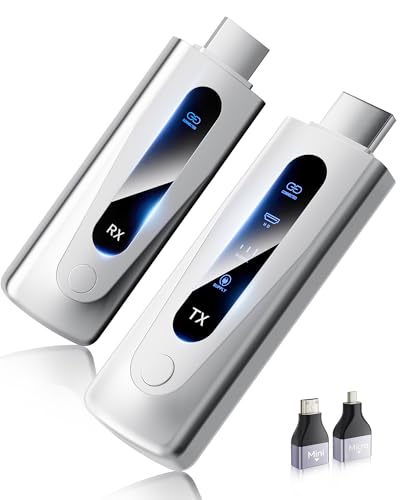
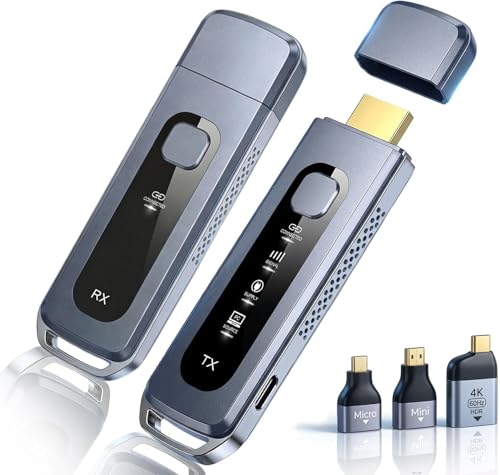
This product is ideal for users who need a short-term, temporary cable replacement for laptop presentations, projector setups, or casual video playback on a 1080p display. It is best suited for situations where the source device and display are located in the same indoor area, and where quick setup, separate USB power, and occasional reconnections or range adjustments will not interfere with important tasks. The included mini and micro HDMI adapters are also useful for users working with cameras or compact computers that utilize those ports. The maximum resolution of 1080p at 60 fps should be expected and confirmed before using the device.
This product is not appropriate for competitive gaming, live camera management, remote machinery control, medical displays, safety monitoring, or any environment where latency or a dropped wireless connection could cause harm. The claimed latency of under 0.01 seconds lacks verifiable independent testing, and user reports indicate noticeable lag during fast-paced gaming. Additionally, it is not suitable for those requiring certified 4K output, HDR, surround sound, confirmed HDCP compliance, multi-display setups, or proven security against unauthorized wireless interception. Consumers needing independently certified power equipment should look for verified certifications.
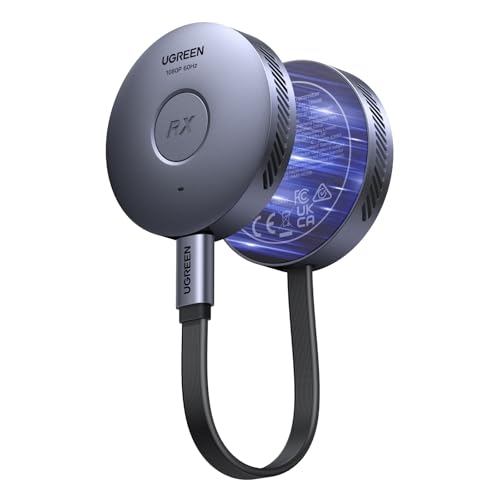
The most reliable safety assurance is derived from radio authorization. The FCC grants for the matching UGREEN transmitter and receiver confirm their operation on the 5 GHz unlicensed band, supported by radio testing evidence and RF exposure documentation. The receiver’s authorization specifies maintaining at least 20 cm distance from people and prohibits co-locating it with other antennas or transmitters. This installation requirement is important because the receiver is designed to sit at a display rather than be held against the body. Regarding electrical safety, the user manual recommends using a UL-compliant USB power supply with a minimum output of 5 V and 1 A. However, no specific UL, ETL, or CSA listing was found for either the kit or the power source sold. UGREEN's EU declaration for the model confirms compliance with RoHS, REACH, packaging regulations, and restrictions on persistent pollutants. Nonetheless, this is a manufacturer declaration and does not provide detailed material-by-material disclosures or U.S. take-back information. Additionally, no product-specific recalls or regulatory warnings were identified in the U.S. sources checked.
This product is ideal for presenters, teachers, renters, or home users who need a quick, temporary connection from a USB-C laptop, tablet, or compatible phone to a single HDMI display. It is best suited for situations where Full HD resolution at 60 Hz is sufficient, the display is located within a clear indoor environment, and the source device supports USB-C DisplayPort video output. Its pre-paired design makes it convenient when installing a long HDMI cable is impractical, and it is intended for regular video playback, slideshows, or desktop tasks rather than time-sensitive control activities.
This device is not appropriate for competitive gaming, live camera monitoring, musical performances, surgical or industrial control, or any tasks where unanticipated delays, compression, or brief dropouts could cause serious issues. It is also not suitable for users who need verified HDR support, surround sound formats, protected streaming compatibility, specific encryption details, or independently tested wall-penetration range. Do not assume that all USB-C phones, tablets, or laptops will work with this device, as the source port must support DisplayPort video output. During operation, keep the radio equipment away from your body, in accordance with its FCC authorization.
The most significant safety-related information is specific to the radio functionality. FCC approval records indicate that the shared Q3 hardware design operates as a 5 GHz wireless HDMI extender, with tested frequency range from 5.18 to 5.24 GHz. The RF exposure condition specified in the authorization mandates that the antenna be positioned at least 20 centimeters away from people. While this provides a meaningful compliance record, it does not replace standard safety precautions such as proper placement, adequate ventilation, or the use of a suitable USB power source. No specific UL, ETL, or CSA electrical safety certifications for this exact product were found. Additionally, there are no model-specific declarations for RoHS compliance, battery details, recycled content, take-back programs, repair services, or certified recycling pathways. A search for relevant U.S. recalls yielded no results. The product is powered externally via USB rather than including a mains power adapter, which limits verification of wall power safety. Nonetheless, the quality of the cable and power source remains important for safe operation.
This product is ideal for presenters, teachers, event staff, or home users who need to position a display or projector at a distance from an HDMI source, with a mostly clear line of sight between them. It is well-suited for displaying slides, playing recorded videos, framing camera shots, and basic desktop mirroring, where 1080p resolution at 60 Hz is adequate. Additionally, it is suitable for users who can provide a stable 5V USB power supply and understand that the maximum range of 165 feet applies to open areas, not guaranteed for indoor environments.
This device is not appropriate for competitive gaming, live production management, precise camera monitoring, or any application where a slight delay or temporary reconnect could lead to issues. Additionally, it is not suitable for users who require guaranteed casting of content from Netflix, Hulu, Prime Video, or other protected apps from a phone or tablet, as HDCP encryption may prevent such functionality. Do not position the antenna near people for long durations, as the safety guidelines recommend maintaining a minimum distance of 20 cm.
The strongest safety evidence is specific to radio compliance. FCC authorization documents for the closely related Q3 product family confirm operation within the 5.18 to 5.24 GHz range under Part 15 regulations and specify a minimum separation of 20 cm between the antenna and users. The associated radio testing report was conducted by Shenzhen CTA Testing Technology, whose current A2LA accreditation encompasses telecommunications and FCC emission testing. The kit is powered by low-voltage 5V USB-C power supplies; however, no model-specific UL, ETL, or CSA safety certifications for the finished product or its power components have been identified. Additionally, there is no model-specific disclosure regarding RoHS materials, Proposition 65 warning information, EPEAT registration, take-back programs, or repair parts plans. No CPSC recalls were found during the search, but the available documentation does not indicate the existence of a comprehensive e-waste management or hazardous materials program.
This product is ideal for home presenters, classroom users, or meeting-room participants who need to display a laptop, camera, media box, or gaming console on a nearby screen without the hassle of running a long HDMI cable. It works best when there is a clear, unobstructed path between the transmitter and receiver, and is suitable for activities such as watching movies, giving presentations, or general viewing. The device supports resolutions of 1080p at 60Hz or 4K at 30Hz. Additionally, it is well-suited for users who appreciate factory pairing and can maintain proper separation between the receiver's antenna and people during use.
This product is not ideal for competitive gaming, live camera management, time-sensitive productions, or other tasks where even a 0.1-second delay could cause issues. Customers requiring verified 4K at 60Hz, HDR, surround sound, precise HDCP compatibility, or clearly documented color formats should select a device with officially tested specifications. It is also unsuitable for setups that demand dependable performance across multiple walls or floors, or for households that need independently certified power equipment and documented options for recycling or repairs.
The Q3 documentation indicates low-voltage USB-C power; however, no specific product listing was found in the UL, ETL, or CSA certification databases for the kit or the supplied power equipment. There is an FCC authorization record for a Q3 wireless HDMI extender operating between 5.18 and 5.24 GHz. The available user manual advises maintaining at least 20 cm distance from the device and using it indoors within the 5.15 to 5.25 GHz band. However, there is no definitive evidence linking this FCC authorization to the exact retail version of the product. Additionally, no AIMIBO-specific CPSC recall has been identified in U.S. recall databases. It's important to note that this does not constitute safety certification. No model-specific disclosures are available regarding RoHS compliance, Proposition 65 warnings, repair procedures, take-back programs, or packaging-material information. When the device reaches end of life, it should be treated as general electronic waste and taken to an electronics recycler rather than disposed of in household trash.
This product is ideal for users who require a temporary indoor HDMI connection for presentations, training sessions, meeting-room displays, or casual videos. The transmitter and receiver should be placed in the same room or within close line of sight. It is best suited for someone who can accept the manufacturer’s specified operating limits, can supply stable USB power, and does not require guaranteed 4K at 60Hz, HDR, surround sound, protected content compatibility, or low latency measurements. The multi-transmitter pairing feature can assist a presenter in switching between multiple pre-connected sources.
This device is not suitable for competitive gaming, live camera monitoring, stage management, medical imaging, security surveillance, or any applications where delays, dropouts, image artifacts, or connection failures could be critical. Additionally, it is not ideal for setups demanding verified 4K at 60 Hz, particular HDR or HDCP specifications, multi-channel audio, or officially tested interoperability. Refrain from using the receiver's hotspot with its default password in environments where unauthorized access to the wireless display feed could have serious consequences.
The FCC authorization documentation for the GTHDWL50UX confirms a 5.8 GHz radio design, an integrated antenna, and successful RF exposure testing for the tested configuration. The manual also cautions that the units can operate at temperatures around 50 degrees Celsius and advises that a flashing power indicator signifies insufficient USB power. Users are recommended to ensure stable USB power supply and proper ventilation, rather than interpreting a warm enclosure as a lack of cooling requirements. There are no specific UL, ETL, or CSA certifications found for the wireless kit or its power supply. Additionally, there is no model-specific declaration regarding RoHS compliance, Proposition 65 warnings, repair programs, take-back initiatives, or certified recycling options. The FCC filing lists Zhuhai Bigway Electronic as the manufacturer, while the retail product bears the HSJINHONG brand, which complicates traceability for support and safety notices. No CPSC recalls were identified in the searches reviewed.
This product is ideal for users who require a straightforward, temporary HDMI connection to a nearby display, such as for presentations, training room monitors, or occasional media setups. It is best suited for environments where the source and display are in a relatively open space, and the user can supply stable USB power at both ends. The device supports 1080p resolution at 60 Hz. While the factory pairing process and status indicator lights can simplify initial setup, users should consider the 50-meter range specified in the manual as a more conservative distance guideline for open-area conditions.
This device is not suitable for competitive gaming, live camera control, production monitoring, or any applications that require guaranteed end-to-end latency. It also performs poorly in long-distance through-wall links, crowded wireless environments, or setups involving HDR or 4K output. Additionally, it is not ideal for multi-display installations or protected-content configurations that demand verified HDCP compliance. For households or workplaces needing independently certified power safety, documented encryption, repair support, or a clear process for recalls and warranty service, it is recommended to choose a product that has publicly available certification and documentation for its specified configuration.
The available A8 documentation confirms an FCC-approved wireless HDMI design, with the corresponding authorization record including Part 15 radio grants and RF exposure information for operation at 2.4 GHz and 5 GHz frequencies. The FCC filing specifies a requirement for a 10 cm separation distance for the antenna configuration. This serves as strong evidence that the device is legally authorized for radio operation, provided the actual hardware matches the documented configuration. However, the electrical safety information is less comprehensive. The user manual indicates a power input of 12 V, 1 A, and a maximum power consumption of 7 W, but there is no verified UL, ETL, or CSA certification for the finished product or its power adapters. Additionally, there are no product-specific RoHS disclosures, Proposition 65 warning labels, repair-part programs, take-back or recycling plans, recycled material claims, or independent recycler pathways available. No relevant U.S. recall notices or safety alerts were found in the records reviewed. The manufacturer's support information is fragmented across TIMBOOTECH, AIMIBO, and the FCC grantee, which may complicate follow-up assistance.
This product is ideal for installers, classroom or meeting-room operators, church technicians, or home users who need a documented method to connect a 1080p source to a remote display while maintaining a local HDMI screen. It is best suited for situations where running cables is inconvenient, the source and display can be powered from nearby outlets, and occasional setup tasks such as pairing, channel selection, or mode adjustments are acceptable. Additionally, the receiver's keyboard and mouse functionality can accommodate a presentation computer stored away from its display.
This device is not ideal for competitive gaming, live camera control, production switching, or any tasks that demand a consistent end-to-end delay and reliable image quality. It is also not suitable for users who need guaranteed 4K output, HDR support, precise audio format compatibility, or verified HDCP compliance for protected streaming services. For households with strict electrical safety standards, it is recommended to use equipment with certified adapters and complete configurations that have a recognized independent safety certification. Additionally, do not depend on the maximum distance specifications when transmitting through walls or floors.
The most significant health-related finding relates to legal radio traceability. The specific wireless device model has U.S. FCC authorization, publicly available 5 GHz radio test data, and an RF exposure compliance submission on file. The designated testing laboratory listed in the radio certification has ISO/IEC 17025 accreditation for EMC and telecommunications testing. This verifies the radio’s compliance documentation but does not serve as a general electrical safety certification for the entire product. There are no UL, ETL, or CSA certifications found for the transmitter, receiver, or power supply components. The user manual states that both units require a 5V/2A power supply and indicates that some warming during transmission is normal; users should avoid enclosed spaces and ensure the use of appropriate power sources. No specific disclosures for RoHS, Proposition 65 warnings, repair programs, recycling initiatives, or material content certifications were identified. Additionally, no product-specific recalls or SaferProducts incident reports from CPSC were found during the searches conducted.
This product is suitable for users seeking a straightforward, short-range cable replacement for 1080p presentations, casual video sources, or secondary displays. It requires both units to be positioned where USB power is accessible. The setup involves HDMI connections on both ends, a 5V/2A power supply, and manual pairing controls. It is ideal for scenarios where a clear line of sight or minimal obstructions are feasible and where a maximum resolution of 1080p at 60 Hz is acceptable.
This device is not suitable for competitive gaming, live camera control, production monitoring, or tasks that require precise end-to-end latency and predictable reconnection behavior. Additionally, it is not ideal for installations requiring a true 328-foot indoor connection or reliable operation through multiple walls, as the user manual specifies a maximum range of 30 meters and notes that obstacles can impact stability. Customers needing verified HDCP support, HDR, surround sound compatibility, or documented wireless encryption should choose a product that has been specifically tested and published with these features.