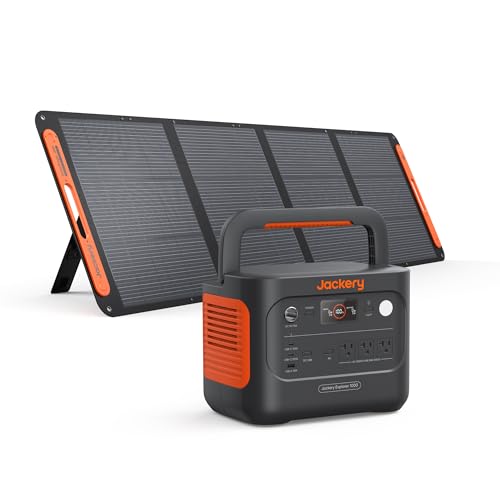
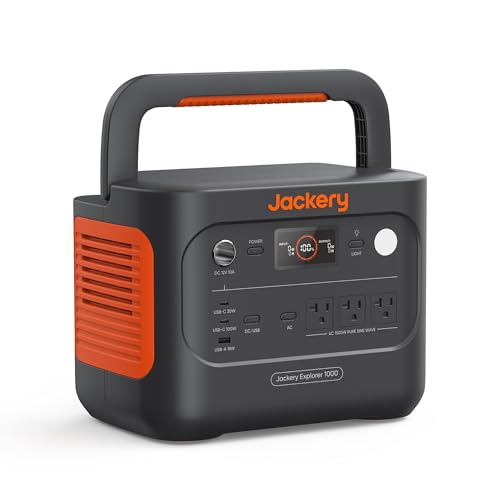
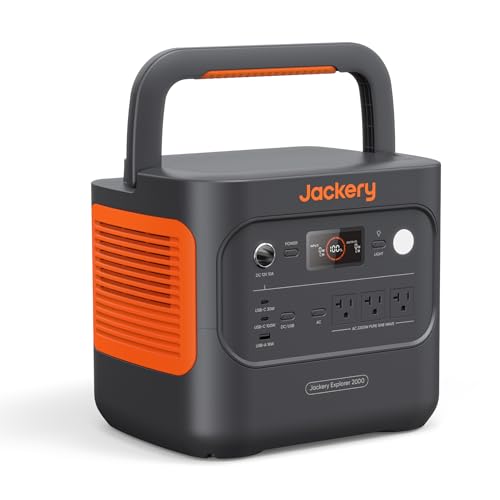
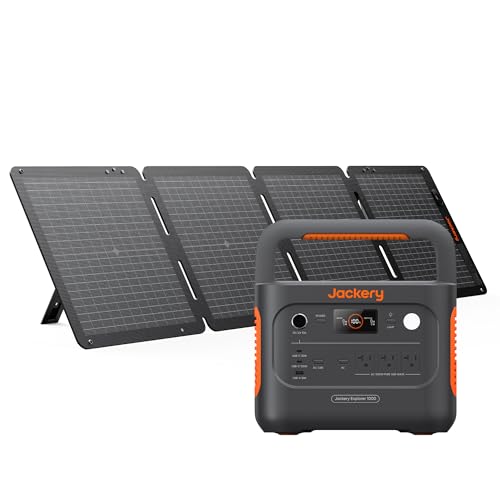
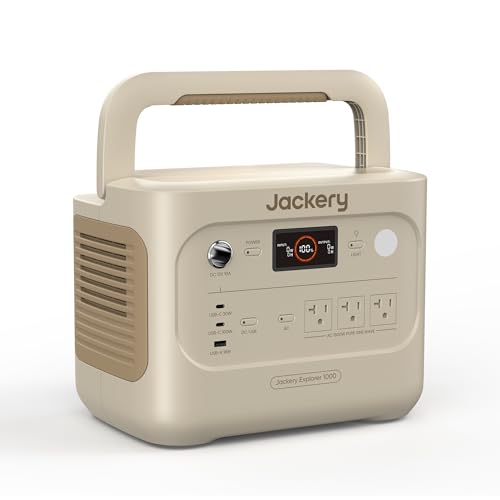
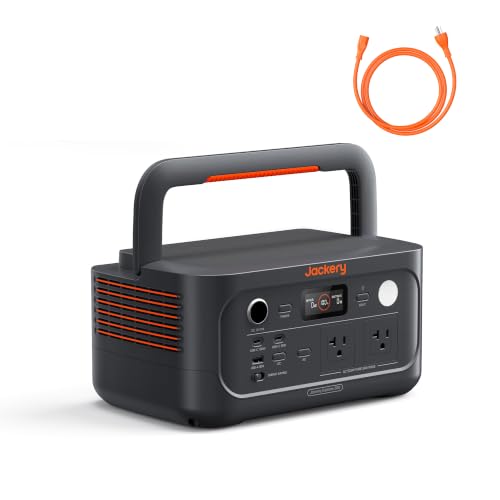
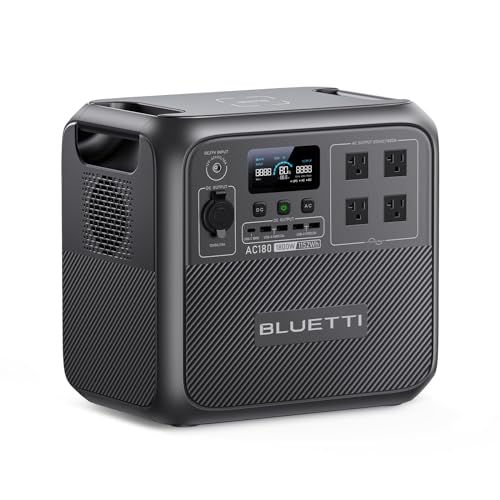
Jackery Explorer 1000 v2 Portable Power Station
Fast 1-hour charging for quick power.
High 1500W AC output for heavy-duty use.
Durable LiFePO4 battery for extended lifespan.
We compared the top Jackery products so you can quickly spot the strongest options for value, features, and everyday performance.
Fast 1-hour charging for quick power.
High 1500W AC output for heavy-duty use.
Durable LiFePO4 battery for extended lifespan.
Fast 1-hour charging for quick power replenishment.
Durable LiFePO4 battery ensures long-lasting performance.
High 1500W AC output supports various electronic devices.
Fast charging, fully recharges in 70 minutes.
High power output with 1500W surge capability.
Durable LiFePO4 battery ensures long-lasting performance.
High capacity battery for extended power use.
Expandable storage up to 24kWh.
Suitable for RV camping and emergencies.
Fast charging: 0-80% in 45 minutes.
High power output: 1800W with 2700W peak.
Versatile use: camping, off-grid, and outages.
Reliable 110V pure sine wave for sensitive electronics.
Convenient foldable 60W solar panel for easy setup.
Lightweight design perfect for outdoor adventures.
Fast charging capability in just one hour.
High-capacity battery ideal for off-grid living.
Durable LiFePO4 battery ensures long lifespan.
High-capacity 518Wh battery for extended use.
Compact design, perfect for road trips.
Multiple output options for versatile power needs.
Long-lasting LiFePO4 battery technology.
Compact design with 200W DC output.
Includes efficient 40W solar panel.
Fast charging capability in just one hour.
Durable LiFePO4 battery for extended lifespan.
High power output suits various outdoor activities.
Portable power stations store energy in rechargeable batteries and supply power through AC outlets, USB ports, 12V outputs, or solar-input systems. They are capable of charging electronic devices, powering select appliances, and providing limited outage support without producing combustion fumes. However, they are not interchangeable with fuel generators, whole-home backup systems, or medical-grade uninterruptible power supplies.
When evaluating these devices, focus on actual usable energy rather than just the battery capacity labeled on the box. For example, a station rated at 1,070Wh may deliver approximately 910Wh via AC outlets in independent tests, while a 512Wh model might provide around 439Wh. Conversion efficiency depends on output type and load: one 288Wh unit delivered 240Wh through AC, but 266Wh via USB-C and 254Wh through 12V. Look for laboratory-tested results that specify load conditions, output type, temperature, cutoff points, and measured watt-hours. Remember, runtime depends on the power draw of the connected device.
Output specifications also require context. Continuous wattage indicates the maximum safe operating limit for appliances, while surge wattage only covers brief startup demands. A device rated at 300W cannot reliably power higher-wattage appliances, and “power lifting” modes may only be suitable for resistive loads rather than continuous inverter output. Reliable assessments should report how the device behaves under sustained loads, including overload protection, AC voltage and frequency stability, grounding, waveform quality, thermal performance, and reset behavior. Claims of 1,500W or 3,000W surge capacity do not automatically mean the device can safely sustain those loads continuously.
Charging capabilities are subject to conditions. A claim of a one-hour recharge time may refer to emergency or rapid-charging modes rather than standard wall outlet charging. Solar panels included with the product are often rated under ideal laboratory conditions; actual performance may be lower in shade, poor orientation, high temperatures, or cloudy weather. Buyers should consult the manual for details on AC input specifications, maximum solar voltage and current, connector polarity, maximum solar wattage, temperature limits, and whether the included panel is optional or part of the package. Never assume that solar and vehicle inputs can be used simultaneously unless explicitly specified.
For safety certification, verify that the complete product (including cables, adapters, cells, or panels) is listed by an OSHA-recognized laboratory. The relevant standard is UL 2743. Confirmation can be obtained through UL Product iQ, Intertek’s ETL directory, CSA, TÜV Rheinland, or the laboratory’s official certification records. A manufacturer’s statement that a product “meets” a standard is less reliable than a current, model-specific public listing.
Backup functionality claims should also be scrutinized. A transfer time of 10ms or 20ms is not equivalent to zero-interruption UPS power. Many manuals exclude critical devices like servers and workstations, and reviews often do not confirm suitability for medical devices. Users should follow the equipment manufacturer’s guidelines and conduct compatibility tests rather than rely solely on emergency-power features for life safety.
Important safety cautions include: these devices should not be used as sole backup for life-sustaining medical equipment; many are unsuitable for servers, workstations, or sensitive electronics requiring seamless transfer; high-power loads for heating, cooking, motors, compressors, or whole-home use often exceed their capacity. Lithium batteries must be maintained within specified temperature ranges, kept dry, ventilated, and protected from damaged cords or housings. Sealed batteries generally cannot be replaced or repaired by the owner. Do not dispose of these products in household trash or curbside recycling; instead, take damaged units to a qualified lithium-battery recycling facility or household hazardous waste collection.

Health and Ecology The following topics highlight the practical risks and gaps in evidence that are important when purchasing and using a rechargeable battery power station. The scores differentiate products based on model-specific testing and clearly defined standards from those primarily backed by manufacturer claims.
This measure protects against overheating, short circuits, overloads, electric shocks, unsafe charging, damaged cords, heat, moisture, and improper disassembly. High-rated products combine clear manual instructions and warnings with robust protection features; for example, a well-documented portable station received a score of 91. In contrast, products with primarily manufacturer-stated protections or incomplete implementations scored in the low 70s.
This assessment evaluates whether the AC output remains stable under specified loads and whether the system shuts down predictably during overload conditions. It considers waveform quality, grounding, surge response, and thermal behavior. This is important because a station’s maximum capacity does not guarantee it can safely operate devices such as motors, heaters, or compressors. The scores provided range from 63, indicating ongoing concerns with overload and cooling, to 90, reflecting comprehensive testing of sustained load performance and immediate shutdown capabilities.
This assessment evaluates whether wall, vehicle, and solar inputs specify clear limits for voltage, current, connectors, polarity, temperature, and overheating. Higher scores indicate realistic charging claims and well-defined, bounded inputs, while lower scores suggest missing protection details or unresolved connection risks. The products tested scored from 52, due to a detected parallel-input hazard, up to 85, which demonstrated detailed limits and more robust charging evidence.
This assessment evaluates verified transfer performance, pass-through limits, outage recovery, and restrictions for medical or life-sustaining equipment. Achieving a high score requires more than just a claimed millisecond response time; it also demands clear warnings and, ideally, independent transfer testing. The highest scores, such as 88, were awarded when a PC and NAS remained powered during a practical outage test, while lower scores reflected unverified transfer claims or vague limit specifications.
This assesses whether claims regarding cycle life and capacity retention specify clear endpoints, testing conditions, storage instructions, and temperature controls. Extended service life can decrease the need for early replacements; however, manufacturer-provided cycle figures do not necessarily match independent aging data. The highest scores were awarded at 85°C, where details about chemistry, temperature conditions, and a defined 4,000-cycle endpoint were provided, while the lowest scores were given at 55°C, where the listing and support claims were inconsistent.
This assesses whether owners have a practical U.S. takeback, recycling, or household hazardous waste disposal option, as well as providing safe instructions for handling damaged batteries. High scores indicate a documented trade-in or recycling process; lower scores suggest no clear manufacturer program or uncertain eligibility for U.S. disposal. Among the products evaluated, scores ranged from 69 to 80, and none should be disposed of in regular trash or curbside recycling.
This assessment evaluates warranty coverage, firmware support, service availability, replacement parts, and whether a battery can be repaired or replaced instead of being disposed of after minor issues. A sealed battery restricts owners from performing repairs, even when support is accessible. The provided scores ranged from 70 to 79, with higher ratings generally associated with five-year warranties, various service channels, robust firmware support, or upgrade options.
This assesses whether the entire, precise power station is currently certified by an OSHA-recognized laboratory according to the relevant portable power pack standard, such as UL 2743. A label on a cable or adapter does not confirm the certification of the station itself. Products with high scores typically have a publicly available SGS listing for the complete model, achieving a score of 97. In contrast, products lacking a verifiable NRTL listing generally score between 68 and 72.
This device's performance was independently evaluated by testing watt-hours, conversion losses, and continuous AC, DC, and USB output under specified load conditions. These measurements are important because the manufacturer’s rated capacity often overestimates the actual power delivered to a device. The highest test score, rated at 91, was achieved when the device delivered 993Wh and sustained a 2,000W load. Lower scores were assigned based on observations made without calibrated capacity, waveform analysis, or overload testing protocols.
This evaluation assesses factors such as capacity, recharge time, solar performance, cycle life, surge output, UPS functionality, and environmental claims, ensuring they encompass the conditions that influence the outcomes. High scores differentiate emergency charging from standard charging and distinguish surge capacity from continuous power. Lower scores indicate conflicting information regarding chemistry or durability; the reported range was from 52 to 84.
This assesses whether relevant recalls, incidents, manufacturer alerts, registration, and support procedures are traceable and responsive. The absence of a known recall does not necessarily indicate that a product is free of defects. Higher scores, up to 78, indicate more transparent support or trade-in processes and no identified relevant recalls; lower scores suggest limited post-market information or unresolved accountability issues.
The most significant health and safety achievement is the model-specific independent certification. SGS has listed this product under ANSI/CAN/UL 2743, and OSHA recognizes SGS for its standard related to portable power packs. The user manual specifies charging temperatures from 0°C to 45°C and discharging temperatures from -10°C to 45°C. It also features high and low temperature warnings and advises users to ensure proper ventilation, avoid water contact and damaged cables, and prevent heat exposure. The lithium iron phosphate battery is rated by the manufacturer for at least 4,000 cycles while maintaining a minimum of 70% capacity. This could lead to reduced replacement frequency, although the cycle life has not been independently verified for this specific model. The product includes a three-year warranty that can be extended to five years upon registration. Currently, there is no verified U.S. manufacturer takeback program or consumer repair parts route. When the product reaches the end of its life, it should not be discarded in trash or curbside recycling. EPA guidelines recommend utilizing a specialized battery recycler or household hazardous waste program, particularly if the unit is damaged.
This device is ideal for campers, road-trippers, or households preparing for short power outages, requiring approximately one kilowatt-hour of portable energy. It is suitable for appliances that operate within a combined AC limit of 1500W. Additionally, it is convenient for charging laptops, phones, lights, cameras, portable coolers, or small appliances, especially with the 100W USB-C port that eliminates the need for a separate laptop charger. Weighing 23.8 pounds, it is manageable for a single adult to carry, though it remains somewhat heavy for extended distances.
It is not suitable as the only backup power source for life-sustaining equipment, servers, workstations, or other loads that cannot withstand any transfer interruption. The specified 20ms transfer time does not qualify it as a true zero-interruption UPS. Additionally, it is not appropriate for buyers requiring continuous, high-wattage heating, air conditioning, large cooking appliances, or multi-day whole-home backup, since the available AC energy capacity is approximately 910Wh according to an independent test. Users expecting quick recovery from solar power should also consider the 400W solar input limit and the influence of weather conditions on performance.
The LiFePO4 battery chemistry and the manufacturer’s claimed 4,000-cycle lifespan indicate good durability. The user manual provides important safety guidelines regarding temperature, ventilation, product damage, and moisture. It advises users to cease usage if the unit overheats, emits unusual odors, becomes damaged, or is dropped hard. Additionally, it warns against opening the battery, using damaged cables, and disposing of the product as household waste. The power station’s full power capability has not been verified by any current UL, ETL, CSA, or other recognized testing laboratory. Jackery only confirms that the included AC cable is UL listed. There are no reports of CPSC recalls specifically related to this product. Jackery offers a trade-in program in the U.S. to evaluate returned units for refurbishment or recycling. However, the sealed internal battery limits repair options, making manufacturer support crucial.
This product is ideal for campers, RV travelers, or households preparing for brief power outages, requiring approximately 0.9kWh of standalone AC energy in a lightweight, one-person carry design. It is suitable for charging electronic devices, operating a cooler, lighting, small kitchen appliances, or other devices within a continuous 1,500W limit. The included solar panel can be beneficial in sunny conditions, as long as the station and connections remain dry. It is also suitable for users who are comfortable monitoring load wattage, temperature, and charging status via the app or on the device’s display.
This product is not suitable for outdoor use in rain, snow, wet campsites, or marine environments, as it has no water or dust resistance rating and the manual specifies indoor use only. It should not be used for life-sustaining equipment, data servers, workstations, or any applications where an interruption in power transfer cannot be tolerated. Customers requiring continuous high-power operation, expandable battery capacity, user-replaceable batteries, or a verified public safety certification for the entire unit should seek a product designed specifically for those requirements.
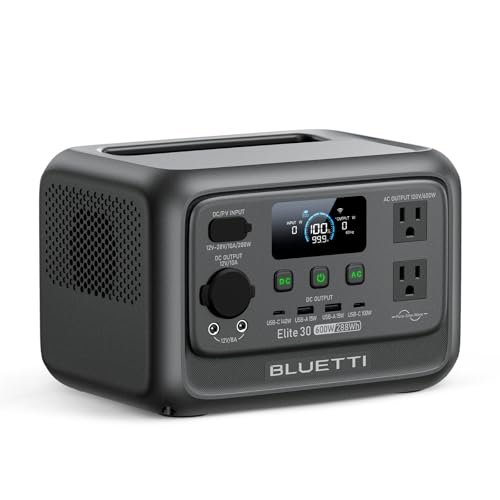
The product utilizes LiFePO4 battery chemistry, which BLUETTI combines with a battery management system and thermal management features. The manufacturer highlights a continuous output of 600W, grounding options, and a five-year warranty. While these features contribute to safer usage, the relevant public certification databases did not list this specific portable power station under UL 2743 or an equivalent NRTL certification. Additionally, no U.S. CPSC recalls or safety warnings were found for this exact product during the searches. BLUETTI claims the battery can endure over 3,000 charge cycles and provide up to 10 years of service. However, they do not publish a detailed, model-specific cycle test protocol or specific capacity retention benchmarks. The company offers a U.S. trade-in program, providing a shipping label for eligible devices, and states that returned units are recycled or repurposed. Since this particular product is not listed in their trade-in table, eligibility should be confirmed beforehand. It is important to note that damaged lithium batteries should never be disposed of in household trash or curbside recycling.
It is ideal for individuals who require a portable power source for phones, tablets, cameras, laptops, a router, lights, tool batteries, or occasional low-power AC tasks. The practical, hands-on experience is most relevant for those who need several hours of power for a small desk setup or to recharge multiple devices, rather than running appliances overnight. It is also suitable for users who can utilize the included car-charging cable or add a compatible solar panel, and who are comfortable monitoring wattage before plugging in an appliance.
This is not suitable as the only backup for oxygen concentrators, life-sustaining devices, or other critical medical equipment. Instead, follow the manufacturer’s backup guidelines and use a properly specified power system. It is also not ideal for electric heaters, full-size refrigerators during prolonged outages, high-startup motor loads, or users who need independently verified UPS performance and NRTL certification. Customers requiring measured AC runtime, waveform data, or verified solar safety parameters should choose equipment with documented test records specific to those models.
The product features a LiFePO4 battery, with the manual providing specific guidelines on recommended charging and discharging temperature ranges, alerts for high and low temperatures, fault code instructions, overload reset procedures, and warnings to cease use if the device is damaged, emitting unusual heat, odors, or liquids. During operation, it produces no combustion exhaust; however, the risks associated with lithium batteries remain. Users should ensure proper ventilation, keep the device dry, utilize only approved accessories, and avoid disassembly. While the product page claims it complies with UL 2743 certification standards, there is no verified current public listing for this exact model. Regarding lifespan, Jackery states the battery can endure approximately 4,000 cycles while maintaining at least 70% capacity. An extended warranty is available upon registration. The internal battery is sealed and not meant to be replaced by users, which limits repair options. Jackery also offers a trade-in and recycling program for functional older units. Damaged or faulty lithium batteries require specialized disposal and should not be placed in standard battery collection containers.
This product is ideal for households, RV owners, campers, or jobsite users who require a portable power source for a refrigerator, tools, communication equipment, small kitchen appliances, or other devices with a continuous power draw of up to 3,000W. It is particularly suitable for customers who can manage a unit weighing 61.5 pounds, recognize that solar components are sold separately, and are interested in expanding with compatible external battery packs in the future. Additionally, it is suitable for non-critical backup power situations where a brief 20ms transfer interruption is acceptable, provided the connected devices have been tested for compatibility.
This product is not suitable as the only backup solution for life-critical medical devices, servers, workstations, or any equipment that must operate continuously without interruption. The manual classifies it as an Emergency Power Supply (EPS), not a professional zero-transfer UPS. Additionally, it should not be used outdoors in rain or wet conditions, in extreme temperatures, or with unauthorized repairs, damaged cables, or accessories. Customers who are unable to lift and securely handle the 61.5-pound battery, or those expecting solar panels or expansion batteries included in the standard package, should not consider the basic product as a comprehensive backup system.
The product utilizes lithium iron phosphate battery chemistry and comes with documented instructions for charging, discharging, storage, ventilation, overload, short-circuit, and abnormal temperature scenarios. The user manual advises against using a cracked housing, covering vents, exposing the battery to flammable materials, and recommends using a dry powder extinguisher in case of fire. Charging should only be performed within the temperature range of 32°F to 104°F. While independent AC testing indicates high conversion efficiency, there is no publicly available verification of the manufacturer’s UL-standard certification. BLUETTI claims that the battery can withstand over 3,500 charge cycles to 80% capacity and recommends storing the unit with a 40-60% charge and cycling it every six months to prolong its lifespan. Although no independent aging data are available, these practices are suggested to help extend service life. The product comes with a five-year warranty and offers repair or replacement services, which are positive customer service features. For end-of-life disposal, BLUETTI provides a trade-in program indicating that old products will be recycled or upcycled. However, there is no clearly documented, model-specific takeback process. It is important never to dispose of this battery product in curbside recycling or household trash.
This product is ideal for car campers, occasional off-grid users, or households preparing for power outages that require a portable backup solution for lighting, networking equipment, a portable refrigerator, power tool batteries, or small kitchen appliances. It is best suited for customers who can maintain a total continuous load of 1,800W or less, understand the surges that occur when appliances start up, and seek an independently measured AC runtime close to 1kWh. Additionally, it is suitable for users working within its specified solar input range of 12V to 60V and up to 500W, and who have a safe, well-ventilated indoor space for storage.
This device is not suitable as the sole backup for medical or life-support equipment, or for computers and network hardware that require a rigorously tested, high-speed transfer UPS. It is also not ideal for users needing verified system-level NRTL certification prior to storing a large lithium battery indoors, as no publicly available certification records were found. Avoid using it for loads exceeding 1,800W, appliances with high compressor or motor surge demands, whole-home circuit backup, or situations requiring frequent manual transport where its approximately 35-pound weight may pose a handling challenge.
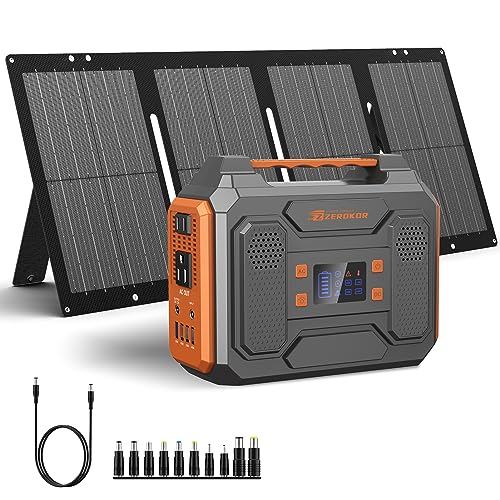
Here is the rewritten version in English, maintaining the key points: An important safety note: this product contains a lithium-ion battery. The manual details features such as overload and temperature protection, an automatic cooling fan, a maximum load of 300W, and an operating temperature range of 14°F to 104°F. While these controls are helpful, there was no independent verification found regarding the overall safety certification or electrical performance of the product. To ensure safety, keep the solar panel junction box dry, only use compatible charging inputs, avoid blocking ventilation openings, and do not use AC power while the station is charging. During research, no relevant U.S. Consumer Product Safety Commission (CPSC) recalls or public regulatory warnings were identified. The manufacturer’s documentation does not mention any takeback or repair programs. When the lithium-ion batteries reach the end of their life, they should not be disposed of in household trash or curbside recycling. The EPA recommends protecting the terminals, preventing damage, and using designated battery collection sites or household hazardous waste programs. The product comes with a one-year warranty and an unspecified cycle-life endpoint, which limits confidence in its long-term durability.
This product is ideal for campers, travelers in vehicles, and households prepared for power outages who require a portable light source for charging phones, tablets, lights, small laptops, or similar electronics that consume significantly less than 300W. It also appeals to users who appreciate including a compact foldable solar panel in the package and can operate within the specified solar input range. Users should be comfortable monitoring power consumption, ensuring vents remain unobstructed, and understanding that runtime estimates are provided by the manufacturer and should not be considered independently verified.
This product is not suitable for powering heating devices, hair dryers, coffee makers, pumps, compressors, or other equipment that exceeds 300W or requires a high startup surge. It is also not appropriate as an uninterruptible power supply (UPS) for desktop computers, critical communication devices, medical equipment, or life-supporting systems. Customers who require independently verified safety certifications, tested usable capacity, known transfer times, extended battery warranties, repair services, or manufacturer-organized recycling options should be aware that such information is not publicly available for this product.
The station utilizes LiFePO4 cells and has clearly defined operating limits. Jackery recommends charging within temperatures of 32°F to 113°F, discharging between 14°F to 113°F, and storing the unit for one year within 32°F to 77°F. The user manual advises maintaining proper ventilation, discontinuing use if the unit is dropped, damaged, overheated, or emitting unusual odors, and keeping the device dry. It also includes temperature alerts and overload protection features. Searches through U.S. Consumer Product Safety Commission (CPSC) recall data did not reveal any recalls for this specific product. Since the battery is sealed, replacing individual cells is neither safe nor supported as a maintenance option. Jackery offers warranty repairs or replacements for confirmed defects, with a standard three-year warranty that extends an additional two years when registered through its official store. The manual does not mention a specific U.S. takeback program for the product. When the device reaches the end of its life, lithium batteries must not be disposed of in household trash or curbside recycling. Instead, EPA guidelines recommend using specialized battery recycling facilities, and damaged batteries should be handled according to manufacturer instructions or hazardous waste regulations.
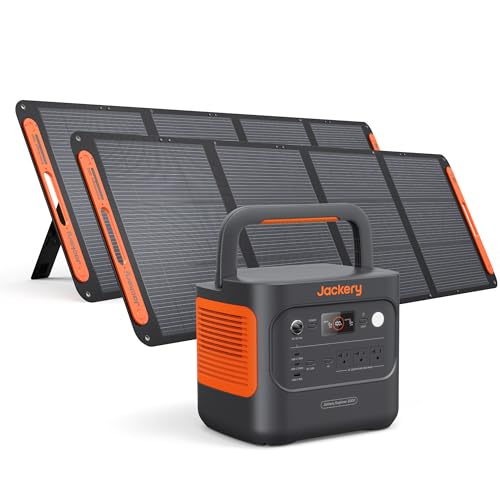
This product is ideal for campers, road travelers, apartment residents, and households seeking a portable power source for moderate loads during brief outages. Its available energy capacity is suitable for charging phones, laptops, powering lights, networking devices, small coolers, CPAP machines (when battery use is approved by the manufacturer), and certain kitchen appliances that do not exceed the 1,500W limit. It is also suitable for users who plan to store it indoors, keep it dry, monitor the load wattage, and understand that the included 100W solar panel provides a slow recharge rather than a quick daily refill.
This device should not be used as the sole backup for medically necessary or life-sustaining equipment, as its transfer functionality has not been independently verified, and neither Jackery nor the device manufacturer should be bypassed. Additionally, it is not suitable for wet, dusty, permanently outdoor, or unattended installations. Customers requiring whole-home backup, expandable batteries, high solar energy collection, or reliable operation of large appliances such as heaters, pumps, compressors, and loads exceeding 1,500W should choose equipment specifically designed and certified for those conditions. It is also not appropriate for users expecting a replaceable battery or routine DIY repairs.
The product utilizes a lithium iron phosphate (LiFePO4) battery chemistry, as identified by Jackery. It specifies operational, charging, storage, and solar-input limits tailored for this particular model. The claimed 20-millisecond outage transfer time indicates a rapid switch; however, it is important to note that this device is not a zero-interruption UPS. Based on publicly available information, there is no record of a recall for this specific product. Nonetheless, a comprehensive listing for certification under the relevant U.S. portable power pack safety standards could not be publicly verified by exact model number. The included AC cable is reported to carry a UL mark, which provides limited assurance compared to full product certification. The manufacturer claims the battery can endure approximately 6,000 cycles while maintaining at least 70% of its capacity. Achieving this cycle count could lead to less frequent replacements, although an independent cycle-life test has not been found. Jackery’s warranty policy covers repairs or replacements for defects that are covered, but it states that the internal battery is not user-replaceable. The company also offers a return-for-recycling program; however, detailed policy information is primarily available through its Canadian service website. U.S. customers should verify the available end-of-life recycling options before relying on this program.
This product is ideal for campers, road travelers, apartment residents, and households requiring portable short-term power for low to moderate loads. Its independently measured AC output is suitable for charging phones and laptops, powering lights, routers, cameras, fans, and similar electronic devices. It is particularly beneficial for users who prefer quick wall recharging and can maintain a total AC load at or below 500W. The specified solar input limits are straightforward, allowing for a properly matched portable panel configuration, as long as the user verifies voltage, polarity, connector compatibility, and weather conditions beforehand.
This device is not suitable for continuous entire-home backup, electric heating appliances, microwaves, kettles, hair dryers, large pumps, or equipment with unpredictable startup surges. Its 20 ms backup feature should not be considered a true uninterruptible power supply (UPS) for servers, workstations, or any equipment that cannot withstand a transfer event. Additionally, it is not appropriate for life-supporting or medically critical devices unless the manufacturer and a qualified professional have verified compatibility and backup needs. Customers requiring on-site repairs or replaceable batteries should not expect these options with this sealed design.
The product utilizes lithium iron phosphate chemistry, which Jackery claims is rated for at least 6,000 charge cycles while maintaining at least 70% capacity. This provides a more precise indication of durability compared to a simple lifespan statement, although no independent or manufacturer-specific cycle testing protocols for this exact model were identified. Jackery specifies an operational temperature range from -4 to 113 degrees Fahrenheit. However, the available documentation does not clearly outline all charging fault protections, and a publicly available safety certification for the entire product could not be confirmed. No relevant U.S. CPSC recalls or safety warnings were found during research. While Jackery offers customer support, warranty, and repair services, there appears to be no dedicated catalog of replacement parts or consumer repair guides specific to this model. For disposal, the internal battery must not be discarded in regular trash or curbside recycling. The EPA recommends taking the battery to a designated collection point or household hazardous waste program, and advises consulting manufacturer instructions if the battery is damaged.
This product is ideal for travelers, campers, outdoor photographers, drone enthusiasts, or remote workers whose essential equipment is already powered via USB. It is particularly suitable when lightweight portability, a compact, bag-friendly design, and high-wattage USB-C charging are priorities over powering household appliances. The solar kit can provide an off-grid charging option for low-power electronics, though users should be aware that panel output varies significantly based on sun angle, weather conditions, and temperature. Additionally, it can serve as a limited backup power source during outages for communication devices.
This product is not suitable for household use with air conditioning appliances, CPAP machines that require AC adapters, kitchen appliances, air pumps, mains-powered tools, or any device that needs a wall socket. It should not be considered a UPS or a life-safety backup, as it lacks transfer time and critical-load testing, and it does not provide AC output. Buyers requiring independently verified safety certifications, accurate measurements of usable watt-hours, or documented high-load thermal testing should not rely solely on the provided product information.
The primary safety concern for this product is notably strong for its category. SGS's public certification records confirm that the product complies with the ANSI/CAN/UL 2743 standard for portable power packs. The user manual includes important safety information such as temperature ranges for charging and discharging, visible warnings for high and low temperatures, guidance on overload recovery, ventilation instructions, and specified limits for AC and solar inputs. A review of the U.S. Consumer Product Safety Commission (CPSC) recall database revealed no active recalls for this specific product. This device's battery utilizes lithium iron phosphate chemistry and is rated by Jackery to endure at least 4,000 cycles while maintaining a capacity of 70 percent or higher. These cycle and storage temperature specifications provide consumers with an idea of the product's longevity, although independent aging data is not available. The battery is sealed and not designed for user replacement. The warranty covers three years, with an optional two-year extension available upon registration; however, access to repair services and replacement parts is limited. Disposal requires special handling through an approved battery or household hazardous waste collection program, rather than standard curbside recycling.
This device is ideal for campers, road-trippers, or households preparing for brief power outages. It provides approximately 0.9kWh of independently measured AC energy and can support individual loads up to a combined total of 1,500W. It is also suitable for users who prefer a relatively lightweight station weighing around 23.8 pounds, featuring three AC outlets, direct USB-C charging up to 100W, and a publicly verifiable safety certification. Solar users should already be familiar with panel voltage requirements, connector compatibility, and the 400W maximum input limit.
This device is not suitable as the primary backup for life-critical medical equipment, servers, workstations, or other loads that cannot withstand any transfer interruption. While it claims an emergency power switching time of within 20ms, the manual explicitly states that it is not a professional UPS. It is also not appropriate for users requiring multi-day whole-home backup, continuous AC output exceeding 1,500W, user-replaceable batteries, or a documented manufacturer battery recycling program. Additionally, it is not designed for high-demand solar systems exceeding 400W input.